

Interested in enrolling your child at TLC? We are committed to providing the best education, resources and supports available. We take our admissions process seriously, and want to engage our families and caregivers in every step of the process.
Once you contact our Admissions Team using one of the forms below, we will begin a multi-step process to ensure our school will be the right fit for your child(ren). We welcome inquiries year round!
A Proud MAAPS 766 School
TLC is a member of the Massachusetts Association of Approved Special Education Schools (MAAPS); a Massachusetts Department of Elementary and Secondary Education (DESE)-approved special education school specifically designed to serve students whose individualized educational needs cannot be fully met in their current public school setting.
As MAAPS 766 schools, Marie Philip School and Walden School provide specialized educational programs designed to meet the unique needs of Deaf and hard of hearing students.
To start our admissions process, please fill out the Inquiry button above, and our Admissions Director will be in touch shortly.
How Does the Admissions Process Work?
Part I: How Placement Decisions Are Made in Massachusetts
- It starts with the child. A team develops an IEP (Individualized Education Program) based on the student's actual needs — not on what's cheapest or easiest.
- There's a range of placement options — from a general education classroom all the way up to an approved out-of-district special education school — and the team chooses based on the IEP, not the price tag.
- The state backs this up. Massachusetts treats students with significant needs as a shared responsibility, not something one school district's budget has to absorb alone.
- The "Circuit Breaker" is the key mechanism. Since 2004, this state fund has reimbursed districts 75% of the costs above a baseline amount when a student needs an approved out-of-district placement — so districts aren't penalized for doing right by kids.
- But it's not automatic. The legislature has to approve this funding every single year, which means ongoing advocacy is essential to keep it protected.
Learn More: How Placement Decisions are Made
Part II: Understanding School District Reimbursements for Out-of-District Placement
- The need is real and growing. 20.6% of MA students receive special education services — well above the 15% national average — and that number has doubled over the past 40 years. Autism diagnoses alone are up nearly 600% in the last decade.
- Costs are tied directly to need. The IEP Team (districts + families) determines what a student needs; approved schools provide those services at cost, with strict state oversight — including salary limits, financial disclosures, and a ban on profit.
- Districts don't foot the bill alone. Funding comes from three levels: local, state (via the Circuit Breaker, Ch. 70, and related laws), and federal (via IDEA).
- The state covers the majority of extra costs. Massachusetts reimburses districts 75% of tuition costs above a set baseline, plus transportation — and recently added $190M for FY'26 and one-time funding to fully cover inflation spikes.
- Federal support matters too — and it's falling short. MA received about $344 million in IDEA funds in 2025, but federal law has never fully funded its promised share, leaving a bigger burden on state and local budgets.
Learn More: Why funding matters — the Numbers
Part III: How Out-of-State Referrals Work
Our MPS Residential Program provides 7-day dorm accommodations for day students who live outside of Massachusetts or live too far to commute every day. In addition, Walden School provides both a specialized educational program and a 365-day residential program, so referrals involve two coordinated processes:
- Residential Placement
- Residential referrals are made through the appropriate state agency or department responsible for determining eligibility for residential services. This process evaluates the student's need for a structured therapeutic living environment.
- Educational Placement
- Referral and placement processes vary by state and by each student’s circumstances. Referrals may come from school districts, DCF/CPS agencies, or other authorized organizations. Walden works closely with the referring agency and family to determine program fit and navigate the educational and residential placement process.
Learn More: Contact our Walden Admissions Team
Walden’s consistent adherence to professional standards, efficacious teaching methods, and respect for the individual child and family should be a model for the nation. We all know that what makes a great school is the “it” factor of the teacher, residence staff, and the school leadership.
From our first day, I had an overwhelming sense of destiny that this is where we belonged. He has thrived in his years at TLC and to see him surrounded by children and adults who know ASL and communicate with him freely is incredible. The barriers to language and full inclusion that sometimes exist in the wider world, don't exist at TLC and William can be himself 100% of the time. He is becoming a proud, confident Deaf boy through his time at The Learning Center.
I am eternally grateful to The Learning Center for the Deaf for providing my whole family a community and language.
Communication Policy
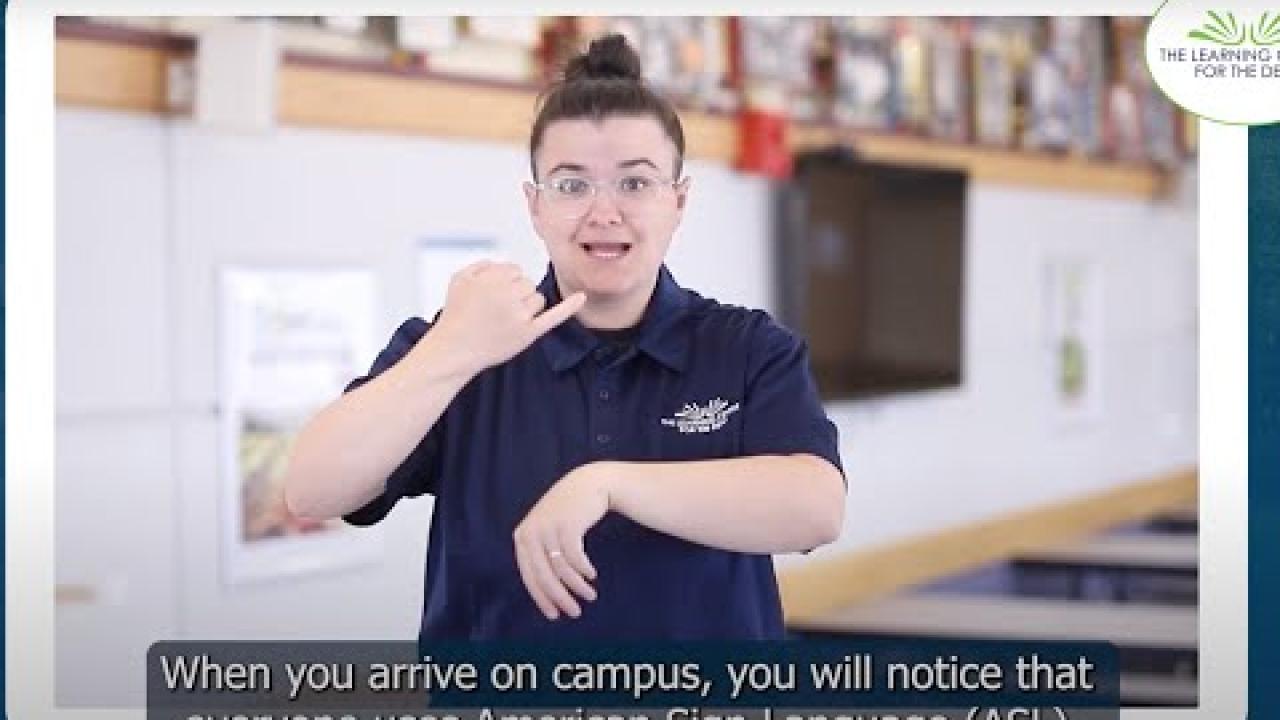
When you arrive on campus, you will notice that everyone uses American Sign Language as their primary form of communication. For our hearing parents, this can often be a new experience. We want to make sure our families understand why we sign at TLC.
Our goal is to provide inclusive, accessible language for everyone. At TLC, we prioritize our Deaf children and staff to ensure they are part of every conversation. It also plays a vital role in fostering a sense of community and cultural identity within the Deaf community.
Checklist for MPS Admissions
For LEAs/District Coordinators:
Please include the following documentation in your referral packet:
- Current Audiogram (*If you do not have an audiogram within the last six months, we can coordinate on-site testing for your child here. Most insurances are accepted)
- Most current IEP or IFSP
- Any evaluations or assessments completed on the student, including: Speech and Communication, Educational Evaluations, Psychological Evaluations, Functional Behavioral Assessments, ASL assessment
Checklist for Families/Caregivers:
After your student is accepted, the following information will be required:
- Health History and Emergency Contacts
- Recent Dental Exam
- Recent Physical:
Provided by the child’s doctor or pediatrician. Physical forms are valid for 13 months. Documentation must include: 1) Lead screening test (ECC/Kindergarten only); 2) Immunization History; 3) TB Risk Assessment 4) Clearance for sports/gym activities or any restrictions.
- Recent Vision Exam
Additional forms may be required and our Admissions Team will communicate with you.